
The decision between Odoo Community and Odoo Enterprise does not always come at the start of an implementation. In many companies, the consideration of a potential migration comes several years later, when the number of users increases, internal needs change, or the recurring cost of licenses becomes a greater concern.
In this context, it may be worthwhile to consider migrating from Odoo Enterprise to Odoo Community. The decision, however, should not be based solely on the price of the licenses. It is also necessary to evaluate the features in use, the maintenance costs, and the company’s technical capabilities.
Key Differences Between Community and Enterprise
Odoo Community is the open-source edition of Odoo and is distributed under the LGPLv3 license. It does not require a fee for each internal user.
Odoo Enterprise includes additional applications, features, and services subject to a commercial license. Depending on the version and the contract, it may offer specific capabilities in areas such as accounting, document management, electronic signatures, support, planning, manufacturing, maintenance, and customization through Odoo Studio.
Both editions share a significant portion of their architecture, but they are not functionally equivalent. For this reason, a company considering migration should analyze its specific installation rather than simply comparing general lists of applications.
The main economic difference lies in the licensing model. In Enterprise, the cost typically increases with the number of internal users. In Community, adding users does not incur a new licensing cost, although it may increase infrastructure, support, and administration requirements. It is also important to note that ending the subscription does not mean that the migration is complete. Enterprise modules must be removed or replaced before the contract ends. Additionally, third-party applications and in-house developments must be reviewed, as they may depend on proprietary components.
Actual Cost of Migration
The most obvious cost savings with Odoo Community are the elimination of Enterprise licenses. However, cost savings with Odoo can only be considered real when comparing the total cost of both alternatives.
With the Community edition, there are still costs associated with infrastructure, backups, support, administration, maintenance, and version updates. The company must either handle these tasks internally or contract them out to a specialized provider. Therefore, it is not appropriate to compare the annual cost of the Enterprise edition with a Community scenario that does not include associated services. The comparison must include all the resources necessary to maintain the system under similar conditions.
Community allows you to choose the infrastructure, the support/maintenance provider, and even the update options. This flexibility can reduce costs when the company has its own technical resources or can contract services tailored to its actual needs.
The Odoo Community Association ecosystem can also facilitate the replacement of some Enterprise features. OCA maintains numerous open-source modules that extend Odoo Community. However, the existence of an alternative module does not guarantee a direct replacement; its functional coverage, compatibility, maintenance, and dependencies must be analyzed.
The cost comparison should cover a period of three to five years. The cost of the Enterprise edition should include licenses, hosting, additional support, customizations, and third-party modules. The cost of the Community edition should include the initial migration, the replacement of Enterprise features, infrastructure, support, and future updates.
For example, a company with an Enterprise cost of 24,000 euros per year would spend 120,000 euros over five years. If the migration to Community cost 30,000 euros and its annual operating costs amounted to 12,000 euros, the total cost would be 90,000 euros. The savings would be 30,000 euros, and the investment would pay for itself in approximately two and a half years.
| Concept | Odoo Enterprise | Odoo Community |
|---|---|---|
| Initial Migration | – | 30,000 € |
| 5-Year Licenses | 120,000 € | – |
| Infrastructure, Support, and Maintenance | Partially covered | 60,000 € |
| Total cost over 5 years | 120,000 € | 90,000 € |
When Migration May Be Justified
Migration can proceed smoothly when a company has a significant number of users but primarily uses features available in Odoo Community. This scenario may occur when the company’s operations focus on sales, purchasing, CRM, inventory, projects, or other standard processes.
Limited dependence on enterprise applications is also advantageous. The fewer proprietary features involved in daily processes, the less effort it will take to replace them.
Another important factor is the organization’s technical capabilities. A company with staff or vendors capable of managing servers, databases, security, integrations, and development can more easily take on the operation of Community.
Migration may also be justified in highly customized installations, where most of the value comes from in-house developments rather than Enterprise modules. In these cases, it will be necessary to verify that the customizations can be adapted and that they do not depend on proprietary code.
The projected growth in the number of users may make the economic factor more important. With Community, costs do not increase directly with each new account, although the infrastructure and support will need to be scaled to accommodate the increase in activity. Additionally, some companies value greater control over the code, data, infrastructure, and vendors. This independence does not always result in immediate savings, but it can be part of a technology continuity strategy.
Before making a decision, it’s a good idea to check whether there are any enterprise applications installed that are rarely used. A functional audit may reveal that a portion of recurring costs is attributable to capabilities that no longer add value to actual processes.
How to Analyze Migration
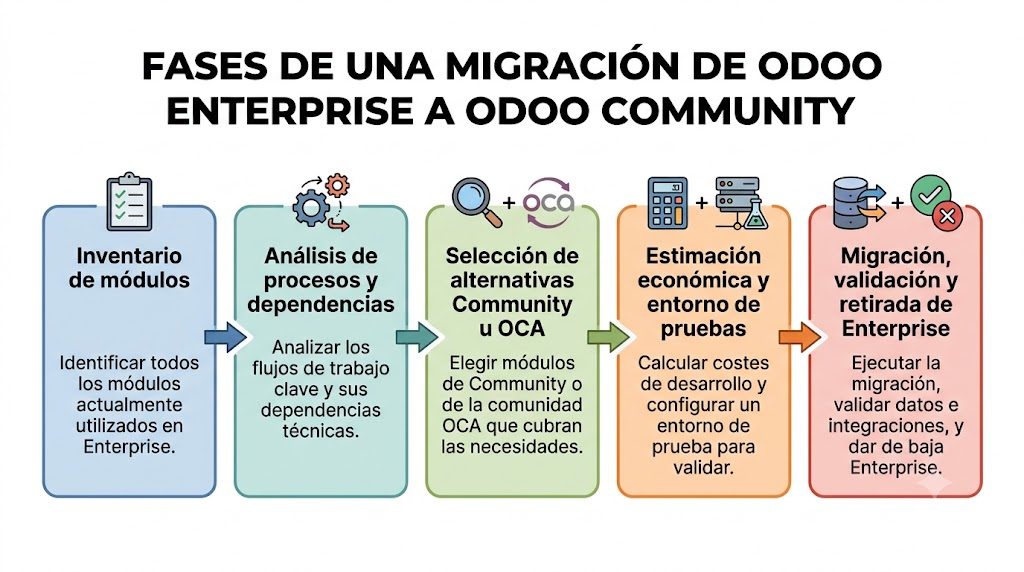
The study should begin with an inventory of the Community, Enterprise, and OCA modules, as well as third-party applications and in-house developments. It is also necessary to identify the customizations created using Odoo Studio.
Next, each module must be linked to the processes it supports. An application that is rarely used may be easy to remove, while a seemingly minor feature may turn out to be essential for a department.
For each Enterprise component, it must be determined whether it can be replaced by a standard Community feature, an OCA module, a third-party application, or a custom development.
Using this information, you can calculate the cost of the migration and compare it to the expected savings. The budget should include testing, training, initial support, infrastructure, maintenance, updates, and a contingency fund for potential changes.
Before making the change, it is recommended that you set up a test environment with an anonymized copy of the database. This environment allows you to validate the data, permissions, accounting processes, integrations, reports, and performance.
Conclusions
Odoo Community can lead to significant cost savings for companies with many users, little reliance on enterprise applications, and the technical capacity to maintain the platform—either in-house or through trusted providers.
The absence of licenses does not mean that the system has no costs. Infrastructure, support, security, and updates are still necessary. The difference is that these expenses can be scaled according to the organization’s needs and are no longer directly dependent on the number of users.
Migration is more feasible when the features used are available in Community or can be replaced with a reasonable amount of effort. A preliminary analysis helps determine which modules need to be adapted, how much the transition will cost, and how long it will take to recoup the investment.
At Ignos, we analyze Odoo Community and Odoo Enterprise implementations from a functional, technical, and financial perspective. This analysis allows us to estimate actual savings and plan the migration before canceling the Enterprise licenses.
This post is also available in: