
Introduction
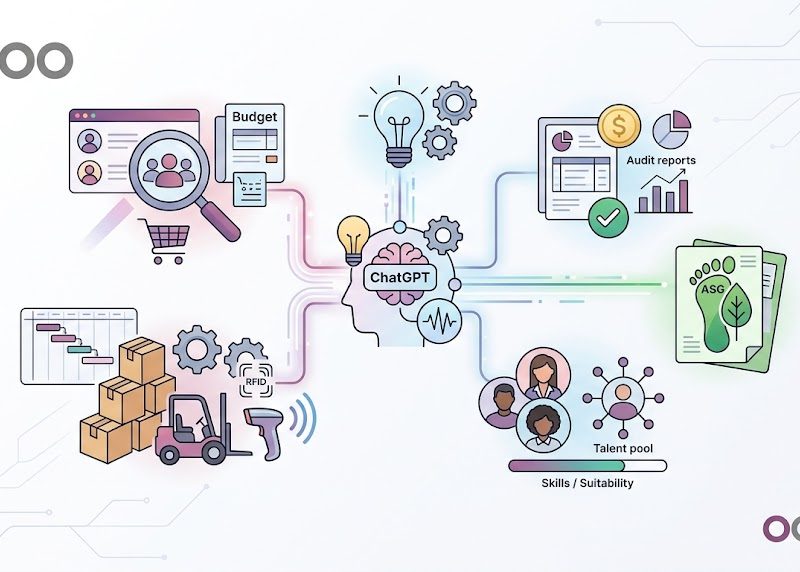
Artificial intelligence, or AI, has become one of the technologies with the greatest potential to transform business management. However, its true value lies not solely in the isolated use of conversational tools (ChatGPT, Gemini, etc.), but in its integration with the systems where an organization’s processes, data, and business rules are concentrated.
In this context, ERP systems take on special importance. An ERP system not only stores information but also coordinates sales, purchasing, inventory, billing, accounting, projects, and customer service. For this reason, applying AI to a management system allows for direct intervention in the company’s actual business processes, rather than merely on unrelated administrative tasks. Throughout this article, we will analyze various uses of AI in this field, illustrating its application on Odoo Community as an open, flexible platform that is particularly well-suited for projects where efficiency and cost reduction are key factors.
AI and Management Systems
For years, management systems have made it possible to digitize operations, automate basic rules, and generate reports. The incorporation of artificial intelligence adds an additional layer: the ability to interpret instructions, analyze large volumes of information, detect patterns, and propose actions based on context.
This development does not mean that AI will replace ERP. On the contrary, its value depends largely on the existence of a well-structured management system with reliable data and defined processes. AI can act as an interface, an analytics engine, or an operational assistant, but it always relies on the information available in the system and adheres to the functional rules that already govern the company’s daily operations.
Task Automation
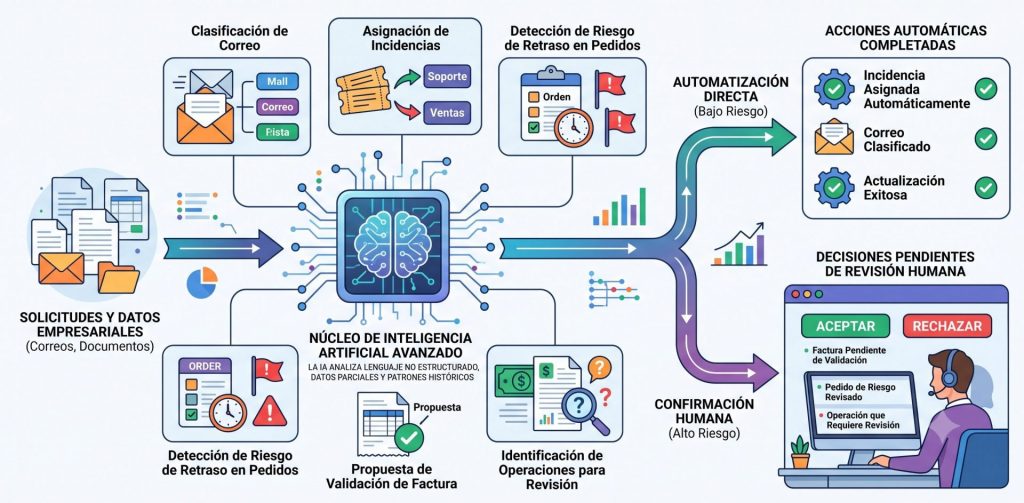
One of the most immediate uses of AI in management systems is task automation. Many ERP systems allow users to define automatic actions, business rules, approval workflows, or notifications associated with specific events. AI makes it possible to extend this logic when the process depends not only on a fixed condition but also on an interpretation of the context.
For example, a system can sort requests received by mail, assign issues to the appropriate department, detect orders at risk of being delayed, suggest invoice approval, or identify transactions that require review. The difference from traditional automation is that AI is not limited to executing a fixed rule; rather, it can evaluate partial information, unstructured language, or historical patterns. This capability must be implemented with care, especially in critical processes, distinguishing between actions that can be executed automatically and decisions that must await human confirmation.
ERP Control Using Natural Language
Another particularly interesting feature is the ability to interact with the management system using natural language. Instead of navigating through menus, forms, and filters, the user can issue a command directly: create an invoice with a specific tax rate, view a customer’s pending orders, prepare a purchase order, or locate products with low inventory levels.
This approach turns chat into a new interface for working with the ERP. It’s not just about answering questions, but about translating human instructions into operations within the management system. For this functionality to be secure, it must be integrated with the permissions system, track the traceability of actions, and request confirmation when relevant data is modified. In a business environment, ease of use cannot be separated from internal controls, especially when AI has the ability to create, modify, or validate information within the system.
Data Analysis and Conversational Queries
Artificial intelligence can also significantly improve data analysis. Dashboards and scorecards remain essential tools, but they are often designed to answer questions that have been anticipated in advance. AI allows for the addition of a conversational layer in which users can ask specific questions without always having to rely on a pre-built report.
A finance department might ask which suppliers with purchases exceeding 10,000 euros are based in Madrid. A sales manager might request a list of customers whose revenue has declined over the past six months. An operations manager might identify products with high turnover and low margins. In all these cases, AI does not replace the data model or information quality control, but it facilitates access to complex queries and bridges the gap between the business question and the data needed to answer it.
In-House Knowledge Management Using RAG
One of the most useful areas of business AI is internal knowledge management. Many companies have manuals, procedures, business policies, warehouse instructions, billing guidelines, technical documentation, or support protocols that aren’t always easy for employees to access. Using RAG (Retrieval Augmented Generation) techniques, AI can answer questions by drawing on the company’s own documentation as a knowledge source.
This type of solution allows an employee to ask how to handle a return, what steps to follow to log an incident, what conditions apply to a particular type of customer, or how to resolve a specific warehouse issue. The same logic can be extended to customers, provided that appropriate permissions and limits are in place, allowing them to inquire about products, availability, sales documentation, warranties, or order status.
Odoo Community as an Example of Practical Application
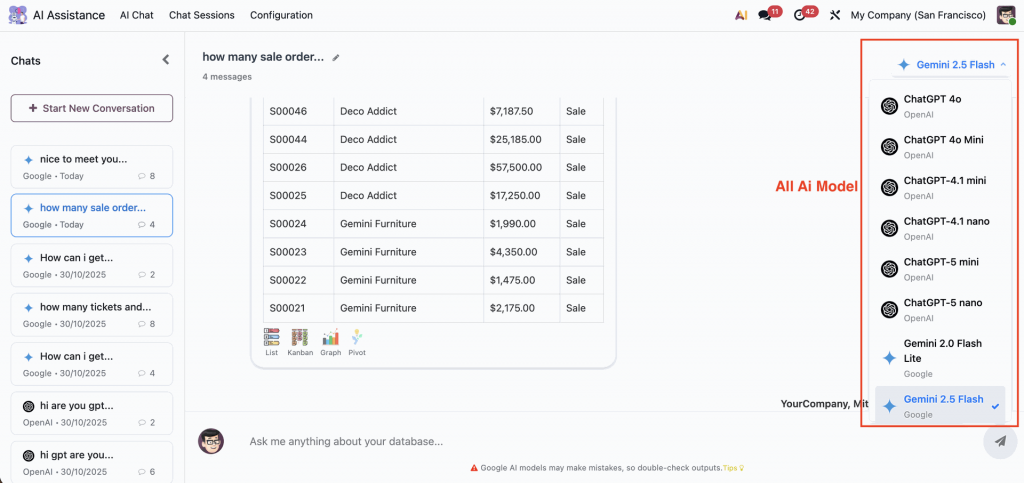
Although the use cases described can be applied to various ERP systems, at Ignos we already have experience implementing AI solutions for scenarios such as those mentioned above: task automation, interaction with the system using natural language, data analysis, and intelligent management of the company’s own information.
These solutions are based on both in-house developments and the integration of third-party modules that incorporate AI capabilities into Odoo Community. This approach allows the solution to be tailored to each organization’s specific processes, avoiding overly complex projects and maintaining a competitive cost compared to implementing equivalent solutions in other ERP environments.
The combination of technical expertise, functional knowledge of Odoo, and integration capabilities allows us to tackle progressive projects that are focused on specific use cases and yield a return on investment that is easier to assess. In this way, incorporating AI into the management system is not viewed as an abstract transformation, but rather as a practical improvement to real-world business processes.
Criteria for Implementing AI on Odoo Community
Implementing AI on Odoo Community does not mean automating all processes right from the start. The most recommended approach is to start with use cases that have a clear impact, available data, and controlled risk. A good starting point might be automating frequently asked questions, categorizing requests, assisted report generation, or smart searches within internal documentation.
It is also important to evaluate data quality, security, access control, traceability, maintenance, and operating costs. AI should be viewed as an investment aimed at improving efficiency, reducing repetitive tasks, and facilitating access to information. Its implementation will be more robust when it is designed as an extension of the management system rather than as an external tool disconnected from business processes.
Conclusions
Artificial intelligence applied to management systems opens up new possibilities for automating tasks, interacting with the ERP system using natural language, analyzing data, and managing organizational knowledge. Its value lies not only in the technology itself, but also in its integration with the company’s actual processes and in the quality of the information it works with.
In this scenario, Odoo Community is a particularly well-suited platform for exploring these types of solutions when a company is seeking flexibility, technological control, and reduced licensing costs. The key lies in identifying specific use cases, implementing security mechanisms, and measuring the return on each initiative. At Ignos, we analyze these types of projects from functional, technical, and economic perspectives, helping companies incorporate AI into their management systems in a gradual, controlled manner that aligns with their business objectives.
This post is also available in: